



Texas gets 37% of its electricity from clean energy. Washington’s carbon market – now linked with California’s – has put more than $5 billion back into communities. And Big Oil executives are asking Congress, the courts, and statehouses to make sure no jury ever holds them accountable.
I just got back from Climate Week in New York energized and ready to continue to work like hell to build a clean energy future alongside all of the incredible people I got to speak with across Manhattan. Here are some of my biggest takeaways from the week, plus a few climate innovations on my radar back home.
I just joined LinkedIn! Let’s connect there, too.
This is a moment for boldness, not timidity, for governors and state lawmakers
In the absence of federal leadership, governors have an obligation to deliver on climate, clean energy, and affordability.
My friend Wade Crowfoot (who is the California Secretary for Natural Resources) said it really well: “We’re not waiting for permission from our national governments or the United Nations to take action to improve people’s lives. Simply put, the world can’t wait.”
One top-of-mind example: During Climate Week, Gov. Gavin Newsom authorized California to move forward on linking its cap-and-invest program with Washington’s.
In 2021, I was proud to sign Washington’s Climate Commitment Act into law. The principle is simple: the state’s biggest polluters have to cut their emissions or pay for them. Since 2023, that market has raised more than $5 billion, and every dollar goes back into Washington communities: electric school buses, heat pumps, solar, EV rebates, and more.
Why does linking our market with California and Québec matter? Because bigger carbon markets are steadier ones. Stability gives businesses the long-term certainty they need to invest in the big, capital-intensive projects that actually cut climate pollution.
This a win for Washington, California, and Québec. And it’s proof that subnational governments (I prefer “supernational”) don’t have to wait on DC to move further and faster on climate change. As former Energy Secretary Jennifer Granholm remarked, “They can build policy from the bottom up — and then link those policies together.”
State leadership like this is exactly why I founded the State Power Project, where my team and I work alongside state leaders to enact and implement policies that deliver a more affordable and prosperous clean energy economy.
The market has already decided on clean energy, and we should be bullish about it
Demand for power is surging like we haven’t seen in decades. Families are opening utility bills with dread. Solar, wind, and batteries are the answer to both problems, delivering more power for less money – faster than anything else on the table. I was able to sit down with Ali Velishi at MS NOW while I was in New York and talk about why this isn’t ideology – it’s just reality. The cost of solar has gone down 80% in the last decade and wind has come down 40% in the last 12 years, as two strong examples of how things have shifted dramatically in a short time.
And Texas is a perfect example of why we should be bullish on clean energy. No one can look at Texas and think that the reason it gets 37% of its electricity from solar, wind and geothermal – and is set to surpass California on battery storage – is part of a political agenda, as Heather O’Neill from Advanced Energy United pointed out during our conversation at Canary Media’s summit at Climate Week.
It’s the market and the market has already decided: clean energy is the most available, cheapest source of electricity. Governors and other state leaders shouldn’t be shy about pointing that out to voters.
And we have to actually build this clean energy future quickly and at scale. Wollemi Capital hosted a fascinating conversation on the status of clean energy investing and climate buildout. As Tim Bishop (Wollemi’s co-founder & co-CEO) pointed out, there are concrete, world-class examples of rapid, large-scale deployment that the US can draw from to overcome complex regulatory and permitting environments.
But Big Oil executives think they’re above the law – and we should all be madder than hell
A major highlight of my week was joining the rousing No Immunity for Big Oil event, hosted by the Center for Climate Integrity and the Union of Concerned Scientists. And I was glad to share the stage with Tennessee Rep. Justin Jones, Angela Kai (former Executive Assistant Attorney General for New Jersey), Dr. Paula Garcia (Executive Director at UCS), and Emily Atkin (journalist at Heated).
Today, Big Oil companies are trying to shield themselves from any accountability in climate-related lawsuits using four nefarious strategies:
The courts: For example, in the Supreme Court case Suncor v. Boulder. The City of Boulder, Colorado wants to hold Exxon and Suncor “accountable for their decades of deception about their products’ role in climate change and to make them pay for the climate damages.” Big Oil wants these types of lawsuits to be declared unconstitutional.
Congress: Federal legislation (the so-called Stop Climate Shakedowns Act / H.R. 8330) is moving through Congress right now, which would grant sweeping legal immunity to oil companies from past, present, and future climate claims.
State legislatures: Similar immunity bills have passed in Republican-led state legislatures, including Tennessee, Louisiana, Utah, Oklahoma, and Iowa.
Attacking climate science: As Dr. Garcia said, there is “a robust body of evidence that we can bring to the courtroom, that we can trace emissions back to the impacts that people are experiencing today, here and now.” But Big Oil is attempting to remove this attribution science from federal judicial reference manuals.
I’m mad as hell about this. In August, devastating fires broke out in my home state of Washington and, according to the most recent data, more than 700 homes were lost. Severe drought, low snowpack, and heat may not have ignited the flames, but these hallmarks of climate change – driven by the fossil fuel industry – made the fires bigger, faster, and more destructive.
In Spokane, I met two brothers whose homes sat directly across the street from each other. Both homes, like those hundreds of others, have been destroyed. One of the brothers, a Spokane firefighter, learned that the fire was approaching their neighborhood and knew his daughter was still at home. He raced to reach her, but police had closed the area and tried to turn him back. He finally made it through just as the flames were crossing the street toward his house. He found his daughter downstairs, curled up in a blanket. When she saw him, she said, “Dad, I was getting ready to die.”
I have thought a lot about her terror and his courage, and I contrast them with the cowardice of these Big Oil executives. These companies rake in billions selling dirty, dangerous fossil fuels and now they refuse to face an American jury, refuse to accept responsibility, and refuse to let their neighbors judge them in court.
If fossil fuel companies have complied with the law, they should have no reason to fear presenting their defense before a jury. We all should stand against this because no one – no one – should be above the law.
Rep. Jones left us with this quote from Frederick Douglass he recites every day on his way into the Tennessee State Capitol and I haven’t stopped thinking about it since:
“Those who profess to favor freedom, and yet deprecate agitation, are people who want crops without plowing up the ground. They want rain without thunder and lightning. They want the ocean without the roar of its waters. This struggle may be a moral one, or it may be a physical one, but it must be a struggle, because find out what a people will submit to, and you have found the exact amount of injustice that will be imposed upon them. The limits of tyrants are prescribed by the endurance of those whom they oppress.”
Watts on my radar
I’ll Raise My Glass to This
If you like beer and care about climate change, this machine’s for you. Before I headed to New York for Climate Week, I got to meet with Michael Weaver in Snoqualmie, WA. Michael is the founder and CEO of Polar Defense, which has a machine called Bubbles. When I asked about the machine, he told me, “We extract [CO2] from the atmosphere, the machine processes it, then we liquefy it and bring it to breweries to inject into their process to replace CO2 that’s derived from fossil sources.”
Then, I spoke with David Skiba (founder and head brewer at No Boat Brewing Company) to ask how they use this CO2. He explained: “CO2 touches our product at almost every level, and it’s always been sourced from fossil fuels up to this point. Now we get to use direct air capture CO2. We basically use it to create a clean, delicious product.” Cheers to climate innovation right here in the Evergreen State.
The Climate Crisis Is Bigger Than Your Footprint
At Climate Week, I also had a fantastic time sitting down with Leah Stokes, Bill McKibben, Sonia Aggarwal, and David Wallace-Wells to talk about Leah’s new book, The Carbon Wave: A Story of Democracy, Parenthood, and the Race to Protect Our Planet. You can read an excerpt from the book here.
I love this line from Leah:
“Rather than thinking of a single person leaving a footprint in the sand, think of waves in the ocean. These waves are made by strong, sustained winds blowing in the same direction. Over generations, these waves are built as thousands of people work together to create change, adding to the efforts of those before them. And just as waves wash away footprints on a beach, our carbon waves can erase our carbon footprints.”
Innovation on the Water
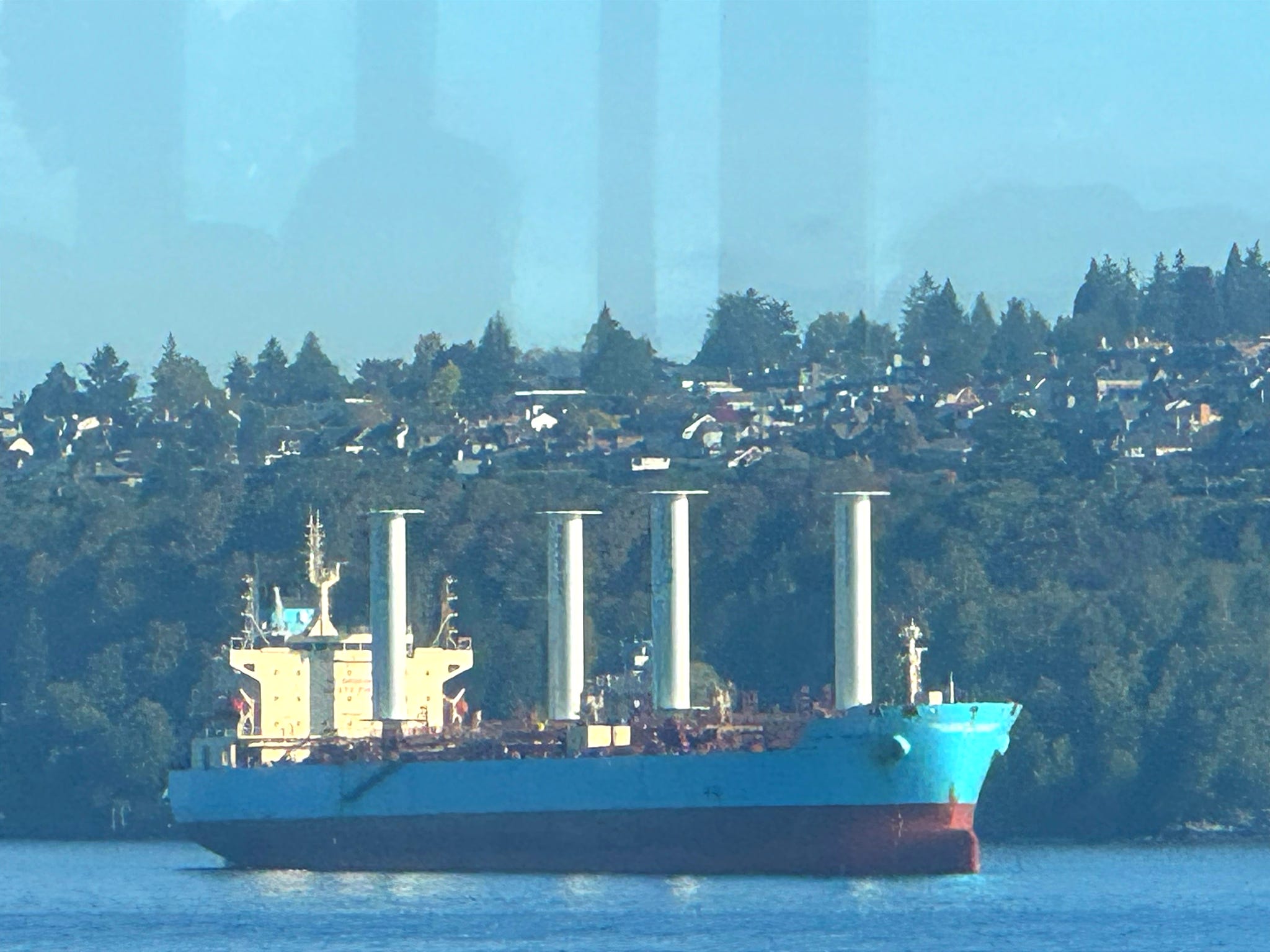
Earlier this week, I caught a glimpse of the Maersk Trieste tanker on Elliot Bay here in Washington. It’s been equipped with “bound4blue” eSAILs, which use suction wind power that can reduce fuel usage and carbon pollution by double digits in some conditions.
Thanks for the update! I've been reading about how local government is putting the kibosh on battery storage of E WA energy that can be used as needed on the west side. It may be that we need legislation allowing climate infrastructure locally similar to the legislation in the past five years to mandate affordable housing. We have an excellent climate program in WA but the ability to generate and store energy is being thwarted locally. What do we do about this?